
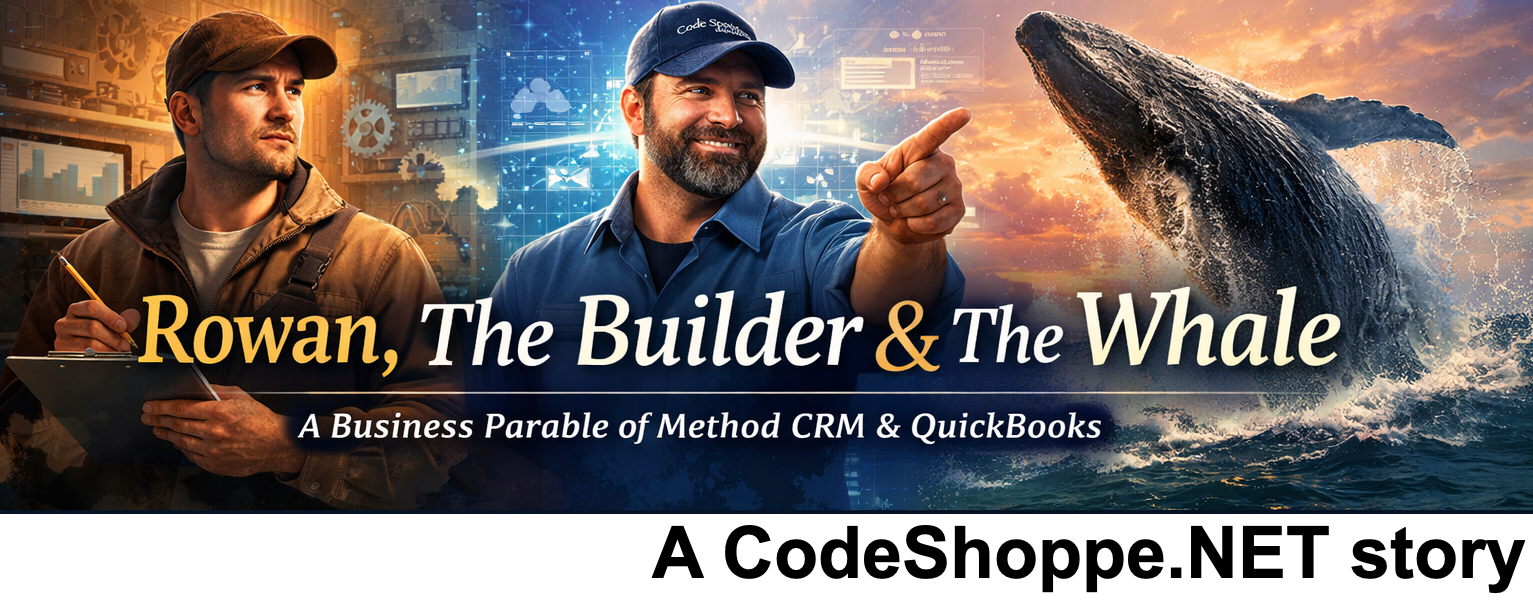
Rowan Hale learned a hard truth the easy way: by trying to ignore it.
The Whale came back—bigger this time, hungrier, speaking in timelines and “asap,” offering Rowan the kind of growth that looks like success from far away and feels like drowning up close.
Rowan said yes anyway, because the business exists to grow, and the man exists to build.
By the second week, the shop was loud with honest work and quiet with dishonest data. A customer was “Acme,” “ACME,” and “Acme LLC,” depending on which screen you believed. Hours were entered twice, then corrected once, then argued about forever. QuickBooks knew the money. The spreadsheets knew the chaos. Neither knew the whole truth at the same time.
Rowan called the Builder.
The Builder arrived without drama, which is how you know he’d done this before. He didn’t begin with software. He began with the only question that matters:
“Where does the truth live?”
Rowan gestured broadly—email, spreadsheet, QuickBooks, memory, sticky notes that had the lifespan of a snowflake.
The Builder nodded once, the way a man nods at a cracked foundation. Then he wrote a single word on the whiteboard:
Method
Rowan had heard of Method CRM the way men hear of lighthouses: as something helpful, distant, and only urgent when you’re already in trouble.
The Builder drew a box.
“This,” he said, “is your database.”
He didn’t say “database” like it was a tech thing. He said it like it was a vault.
“In Method,” he said, “the vault is tables and fields. The business becomes records that can be found, trusted, and used.”
Rowan watched the Builder sketch rows like railroad ties.
“You want one customer,” the Builder said, “not three versions of the same customer. You want one address. One phone number. One list of items that doesn’t mutate when someone’s tired.”
Rowan nodded. He’d lived the cost of mutation.
Then the Builder drew a second box beside the first—gears this time, clean and unromantic.
“This is the logic layer,” he said. “The engine.”
Rowan leaned forward. “You mean workflows?”
“Workflows,” the Builder said, “and rules. Validation. Permissions. Automation. The part of the system that says: you can’t invoice work that wasn’t approved; you can’t close a job with missing time; you can’t ‘sort of’ be correct.”
Rowan felt the relief of a bridge that refuses to collapse just because a truck is late.
Then the Builder drew the third box—wide, bright, almost polite.
“This is the user interface,” he said. “Screens. Buttons. Forms. What your people touch.”
He underlined it twice.
“The UI is where humans live,” he said, “but it is not where truth should be invented.”
Rowan recognized himself in that sentence, and didn’t like it.
The Builder stepped back.
“Those are the three big components,” he said. “Storage. Logic. Interface. In Method, all three are customizable—tables and fields, the rules that move them, and the screens that present them.”
Rowan exhaled slowly, as if someone had finally stopped the leak.
But the Builder wasn’t done. He drew two more shapes—because real businesses always have two more problems than you planned for.
The fourth shape was a printer.
“Report Designer,” the Builder said.
Rowan smiled, tiredly. “Reports. The things we build at midnight.”
The Builder nodded. “Except these aren’t spreadsheet rituals. In Method, you build templates—reports, invoices, estimates, work orders—whatever your business needs to print or share, and you can customize them.”
Rowan imagined a world where a proposal didn’t depend on a single person knowing the right file to copy.
The fifth shape was a bridge.
“Sync Engine,” the Builder said, and Rowan’s eyes narrowed. “Between Method and QuickBooks.”
Rowan sat up straighter. “That’s the part that matters.”
“It matters,” the Builder agreed, “because QuickBooks is your financial historian. It needs clean transactions. Method becomes the operational brain—quotes, jobs, approvals, and the steps that make accounting accurate instead of hopeful.”
The Builder tapped the bridge.
“Method sync is two-way. Changes can flow from Method to QuickBooks and from QuickBooks back into Method.”
Rowan thought about how many times he had typed the same truth twice and called it “efficiency.”
The Builder’s marker squeaked again.
“Now,” he said, “we build the house.”
They started in the vault.
They cleaned the customers first, because the world is made of names. Method refused duplicates the way a good lock refuses a bad key. Rowan watched records become singular again—one customer, one identity, one place to stand.
Then they moved to the engine room.
The Builder added rules that felt almost moral:
-If a job has no approved time, it cannot be billed.
-If an item doesn’t match the catalog, it can’t sneak through with a typo.
-If an invoice is created, it must belong to a real customer, not a ghost in a spreadsheet.
People complained at first. They always do. They confuse new boundaries with new burdens.
Then the complaints stopped, because the fires stopped.
Next came the UI—the windows.
The Builder built screens the way Rowan’s shop actually worked: a view for today’s work orders, a place for technicians to enter time without wandering into forbidden rooms, a simple approval screen for managers so billing could happen without a scavenger hunt.
Rowan noticed something: the system felt calm. Not because it was pretty. Because it was correct.
Then the Builder turned on the printer.
He built a work order template that looked like Rowan’s business—logo, language, the fields Rowan actually cared about, not the fields software vendors assumed every company cared about. He built a proposal that could be generated with a button instead of a prayer.
Finally, the bridge.
The Sync Engine lit up like a control panel, not magical—just precise.
A customer added in Method appeared in QuickBooks without a second entry. An invoice created from a completed job moved into QuickBooks like it belonged there, because now it did. When QuickBooks held something Method needed—an updated balance, a posted payment—it flowed back across the bridge and settled into the same single truth.
Rowan watched this happen and felt something he hadn’t felt in months.
Predictability.
The Whale tested him, as Whales do.
It doubled the work. It pulled a deadline forward. It requested reporting that used to require Rowan to sacrifice a weekend and a small part of his soul.
Rowan didn’t argue. He opened Method.
The UI showed the world as it was.
The logic layer calculated the world as it must be.
The database held the world as it stayed true.
Rowan clicked “Generate Report” and watched the printer produce a clean answer with clean numbers.
Then he called the Whale.
“We can deliver eight by Friday,” Rowan said, “and ten by Tuesday. If you want ten by Friday, you’ll get ten that look like Friday.”
The Whale paused—because even Whales understand a man who speaks from instruments instead of instinct.
They chose Tuesday.
After the call, Rowan stood in the doorway of his office. Same concrete. Same crew. Same honest work.
But now his business had a house with five machines:
1. A vault for truth.
2. An engine for rules.
3. Windows for humans.
4. Reports for proof.
5. And a bridge that kept QuickBooks and operations from becoming two competing religions.
He didn’t call it “digital transformation.” He didn’t need the phrase.
He called it something simpler:
“One place where the business doesn’t contradict itself.”
And for the first time in a long time, growth felt like building—not drowning.
Curious how process automation is helping small businesses grow? Download our free whitepaper. To find out if Code Shoppe is a good fit for you and your business, simply complete the contact form below or click "Book a time now!" to schedule a free consultation directly on our calendar.
Your small business is growing and now the processes and systems that worked in the beginning are taking too much time leading to overwhelm, frustration, and human error. If only there was more time in the day to get it all done. We've got good news, there can be! Code Shoppe helps small business owners, like yourself, get time back, increase productivity and customer satisfaction, and position your business for growth.

Code Shoppe is a business consulting service for small and medium sized businesses(SMBs). We specialize in process automation and integrating all systems into a single source of truth. We have extensive experience building software that integrates with QuickBooks and offer a free initial consultation.
It’s our mission to help you recapture lost or inefficient time!